


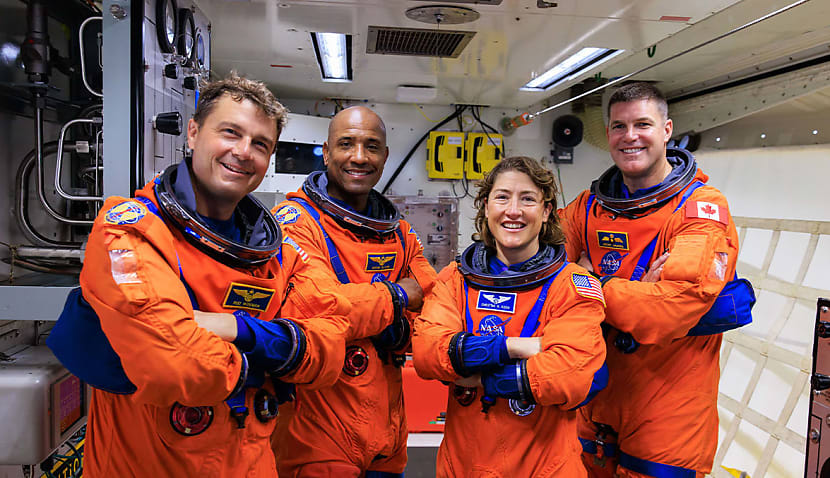
In 2025, the US space agency pushed ahead with preparations for Artemis II, the first crewed test flight of its new lunar program, slated for early 2026. The mission will take astronauts around the moon, testing critical systems ahead of a planned return to the lunar surface later this decade.
The year also saw NASA land two robotic science missions on the moon, expand its international partnerships, and deliver a steady stream of scientific and technological breakthroughs across Earth science, astronomy, and human spaceflight.
Central to that global push is the Artemis Accords, a set of voluntary principles for peaceful, transparent, and responsible exploration of the moon and beyond. Seven new countries signed on in 2025, bringing total membership to almost 60. Australia continued to play a visible role, with NASA co-chairing an Artemis Accords principals’ meeting during the International Astronautical Congress held in Sydney.
On the hardware front, teams completed stacking the Space Launch System rocket and Orion spacecraft for Artemis II at Kennedy Space Center in Florida. The four-person crew ran through dozens of mission simulations and recovery exercises, while engineers tested engines, boosters, spacesuits, and landing systems that will underpin future lunar landings.
NASA also selected 10 new astronaut candidates from more than 8,000 applicants, beginning nearly two years of training for missions to low-Earth orbit, the moon, and eventually Mars.
Beyond human exploration, NASA’s science program delivered a series of headline results. A joint satellite mission with India began monitoring Earth’s land and ice in unprecedented detail, while agency spacecraft helped track only the third known interstellar object ever observed passing through the solar system. The International Space Station marked 25 years of continuous human occupation, hosting astronauts from six countries and supporting thousands of hours of research.
Mars remained firmly in NASA’s sights. Two ESCAPADE spacecraft were launched toward the Red Planet to study how solar activity strips away its atmosphere, a key question for future human missions. Closer to home, laser-based deep space communications tests exceeded expectations, pointing to faster, more reliable links for long-duration crewed flights.
NASA’s telescopes continued to reshape our understanding of the universe. The James Webb Space Telescope entered its third year of operations, Hubble celebrated 35 years in orbit, and final testing began on the Nancy Grace Roman Space Telescope, due for launch as early as 2026.
Back on Earth, space-based research fed into practical outcomes, from improved wildfire detection and weather forecasting to medical advances. Studies aboard the space station contributed to new cancer treatments, advances in 3D-printed medical implants, and better understanding of how the human body copes with long periods in space.
As NASA looks ahead to Artemis II and beyond, the message from 2025 is clear: a sustained return to the moon is no longer a distant ambition, but an unfolding reality – and a stepping stone to humanity’s next giant leap towards Mars.