


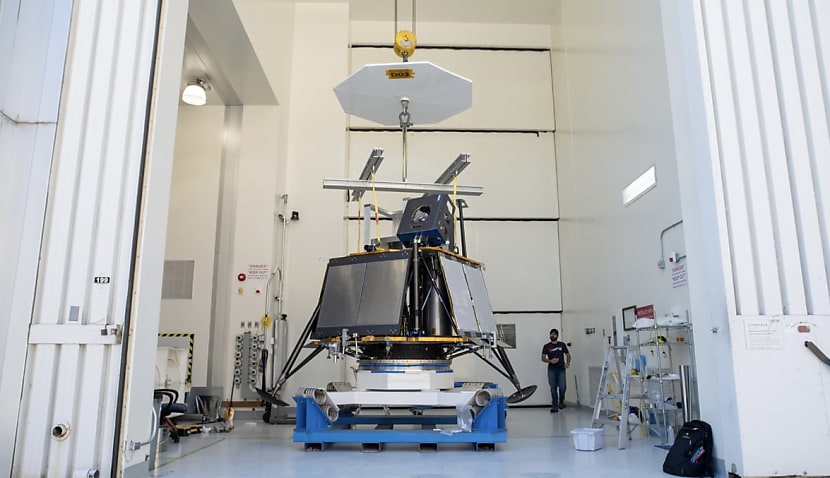
The same facilities that helped prepare the Voyager probes for launch more than 50 years ago are now being used to put Firefly Aerospace’s next lunar lander through a punishing regime of vibration, noise, and temperature extremes.
The testing is aimed at ensuring the spacecraft can survive the violence of launch before heading for the moon’s far side as early as 2026.
Firefly, which achieved a major milestone earlier this year with a successful soft landing on the moon, is now preparing for its second Commercial Lunar Payload Services (CLPS) mission for NASA.
An engineering model of the new Blue Ghost Mission 2 lander has been undergoing intensive trials at JPL’s Environmental Test Laboratory, a cornerstone of US planetary exploration since the 1960s.
Launch conditions are among the harshest environments any machine will face. Rockets shake violently, sound levels climb to extreme levels, and hardware must endure both crushing cold and searing heat.
JPL’s test facilities are designed to replicate those conditions as closely as possible, giving engineers confidence that spacecraft will survive the trip off Earth.
Over the decades, the Environmental Test Laboratory has prepared a who’s who of NASA missions, from early Ranger probes to the Perseverance rover now exploring Mars, and the Europa Clipper spacecraft currently bound for Jupiter’s icy moon.
That depth of experience is now being applied to support industry partners working under NASA’s Artemis program, which aims to return astronauts to the lunar surface.
In recent months, Firefly’s full-scale structural qualification unit – a non-flying version of the spacecraft used purely for testing – was subjected to exhaustive vibration and acoustic trials. Data gathered from hundreds of sensors will feed directly into final testing of the flight hardware.
“There’s an enormous amount of hard-won knowledge in this lab,” said JPL engineer Michel William, who led the testing campaign. “A lot of what makes these tests successful comes down to experience – the small details you don’t learn from textbooks, but which can make or break a mission.”
JPL engineers also supported testing of Firefly’s first Blue Ghost lander in 2024, making its successful lunar landing in March a source of pride for the team. The upcoming mission is even more ambitious.
For the first time, Firefly will fly a dual-spacecraft stack, pairing the Blue Ghost lander with its Elytra Dark orbital vehicle and carrying multiple international payloads.
Standing nearly seven metres tall, the combined structure is more than three times the height of the previous lander. To test it, engineers bolted the model to a massive shaker table inside a clean room and rattled it in three directions.
It was then blasted with sound waves reaching 153 decibels – loud enough to cause permanent hearing damage – generated by giant horns built into thick concrete walls.
As commercial missions take on a growing share of lunar exploration, JPL’s decades-old test chambers are proving they still have a vital role to play in getting spacecraft safely off the ground and on their way to the moon.